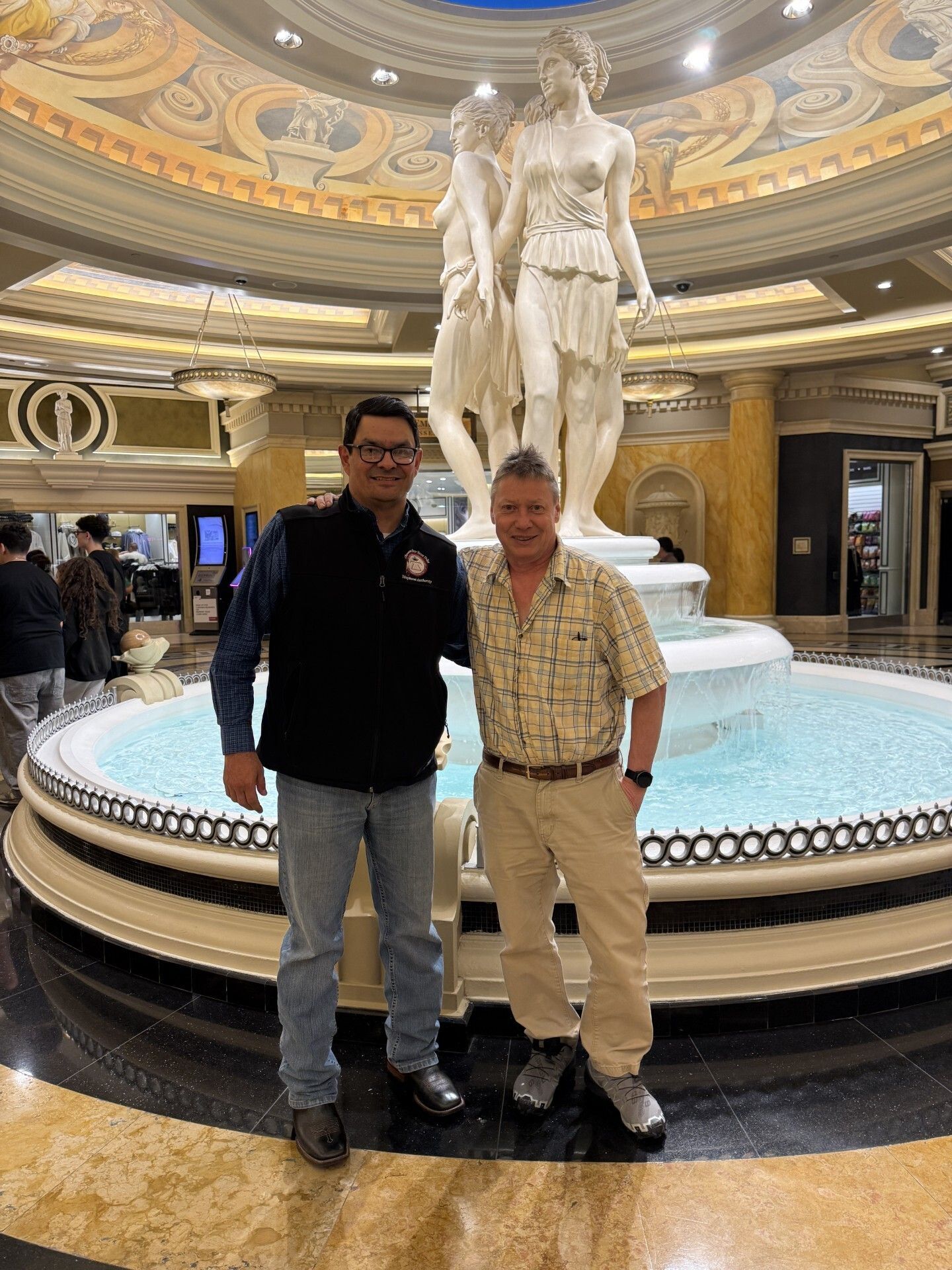
At the May 2026 Native Edge Institute in Bend, Oregon, our team met Jeff Lumpkin and Guthrie Ducheneaux, co-founders of OAHE Data. OAHE has built an impressive database and data tools designed to help tribes be more competitive in grant applications and when seeking out other funding sources for economic and community development projects. OAHE grew out of Guthrie’s and Jeff’s shared recognition that there were two separate but related challenges with data in Indian Country: data sovereignty and turning massive amounts of available data into meaningful action.
We recently asked Guthrie and Jeff to share more about OAHE and what its approach and platforms can do for tribes. If you’d like to learn more, don’t hesitate to reach out to Jeff at jeff@oahe.ai or Guthrie at guthrie@oahe.ai. Thanks to Jeff and Guthrie for taking time out of their busy schedules to share their story.
Want to connect with companies like OAHE? Make sure to join us – either virtually or in person – at an upcoming Native Edge Institute. Find out where we’ll be on our events page!
- What is the story behind Oahe Data, and what gap in tribal data systems were you trying to solve when it was created?
Oahe is a Lakẖóta word meaning “pedestal” or “foundation” — and that name says everything about why we built this company. Guthrie Ducheneaux, our CEO, is Lakẖóta and an enrolled member of the Cheyenne River Sioux Tribe. Before founding Oahe, he worked with Missouri Breaks Industries Research and with Native BioData Consortium — an Indigenous-led nonprofit headquartered on the Cheyenne River Sioux Tribe’s sovereign land that maintains a tribal data repository so communities can own and control their own genetic and health information. That work gave Guthrie a deep, firsthand understanding of a problem that runs through all of Indian Country: research and data have historically been extracted from Native communities without those communities controlling how it’s used, who benefits, or what story it tells.
He saw that same dynamic playing out in economic development, housing, health, and infrastructure — tribal governments competing for the same grants as municipalities and state agencies, but without the same data infrastructure to make their case. Not because the communities lacked information, but because no one had organized federal data in a way that was actually usable by tribal planners, grant writers, and program directors — and that remained accountable to tribal priorities.
Co-founder Jeff Lumpkin's background in business intelligence and healthcare analytics reinforced a key lesson: organizations often have access to large amounts of data but lack the tools to turn it into meaningful action. When Jeff and Guthrie met, they recognized the same challenge from different perspectives and saw an opportunity to build those tools specifically for Indian Country.
When Guthrie and Jeff met, they recognized the same gap from two different angles: the tools that make large organizations competitive had never been built for Indian Country at any meaningful scale.
Our mission is to help tribes transform public and tribal data into actionable intelligence while ensuring it remains governed by tribal priorities and values. Through our FP-STAN data architecture and tools such as the Grant Intelligence Engine, Wowasi Venture Studio, and Veritas Maps, we help tribal nations move from fragmented information to informed action.
- How does Oahe Data help tribes become more competitive in securing grants and funding opportunities?
Strong grant applications require credible data, but the information needed is often scattered across dozens of federal sources. Oahe Data brings those pieces together in one place, helping tribes focus on project development rather than data collection.
Through our Grant Intelligence Engine, we integrate demographic, economic, housing, health, environmental, energy, workforce, and infrastructure data into a unified framework that can quickly answer the questions funders are actually asking. Rather than spending weeks gathering statistics, tribes can focus on defining priorities and building projects. Every number in our data packages traces to a specific federal dataset, vintage, and place code — so grant reviewers can verify every claim.
We also use Wowasi Venture Studio to help organizations develop project concepts into fully articulated implementation plans, complete with budgets, timelines, partnerships, and outcome measures. This helps communities move beyond simply identifying funding opportunities and toward developing projects that are ready to be funded.
Strong grant applications require more than data points — they require evidence-based storytelling. Our role is to help tribes demonstrate need, justify investment, measure outcomes, and communicate long-term impact in ways that resonate with funding agencies.
- What makes Oahe Data different from traditional consulting or data firms working in the tribal and public-sector space?
A few things set us apart. First, Oahe is majority Native-owned. Guthrie brings lived experience as a tribal member and years of work in Indigenous economic development. That isn’t a checkbox — it shapes how we frame problems, which questions we ask, and who we build for.
Second, most data consultants bring generic tools. We built our own data infrastructure from scratch. FP-STAN is a unified observation model that integrates over a billion validated data points from authoritative federal sources, all aligned to AIAN homeland boundaries. That pre-integration is what makes our work fast, our outputs credible, and our platform genuinely different from anything else serving Indian Country.
Third, our product suite is purpose-built for the tribal context. Veritas Maps gives tribal planners and leaders interactive maps and dashboards covering demographics, economic development, housing, energy, health, broadband, and community indicators — at the county, tribal, and reservation level. Wowasi Venture Studio helps transform ideas into investor- and funder-ready plans. The Grant Intelligence Engine turns that data foundation into competitive grant applications. These aren’t adapted enterprise tools — they were designed for this work.
We've occasionally been referred to as "data gurus," but data is not the goal—it's a tool. Our focus is helping tribes build the knowledge and capacity needed to make informed decisions, strengthen sovereignty, and improve outcomes for their communities.
- What are some of the biggest challenges tribes face when it comes to data collection, analysis, and grant readiness — and how does Oahe Data address them?
One of the biggest challenges tribes face is that critical data is spread across multiple agencies and systems that often use different geographies, definitions, and reporting methods. This makes it difficult to assemble a complete and accurate picture of community needs, particularly when federal datasets do not align with tribal boundaries.
We address these problems at the foundation. FP-STAN pre-integrates over a billion observations from the Census Bureau, CDC, AHRQ, BEA, and other federal sources — already harmonized to AIAN homeland boundaries, already aligned across domains. The Grant Intelligence Engine and Wowasi Venture Studio sit on top of that, so tribes can focus on strategy and community priorities rather than data plumbing.
The third challenge is trust — and this one is deeply rooted. Indian Country has a painful history of data being collected about communities, without consent, and used against them. Our Community Data Sovereignty Package deploys self-hosted infrastructure on sovereign land — hardware the tribe owns, with no licensing fees and no third-party telemetry. When the contract ends, the data and the infrastructure stay with the tribe.
- Describe how a strong data strategy directly helped a tribe or organization secure funding or move a project forward.
We’re careful about naming clients publicly without their explicit sign-off, but we can describe patterns we’ve seen more than once.
We worked with a Great Plains tribe preparing a broadband infrastructure application. Standard county-level federal data made the connectivity gaps in their area look moderate. When we built the analysis using AIAN homeland boundaries and layered in FCC broadband availability data at the correct resolution through our platform, the picture was dramatically different — one that accurately reflected the community’s lived experience and made a far stronger case to funders. The tribe submitted with a fully sourced, reviewer-ready data section that would have taken their team weeks to assemble independently.
In another case, a Native-led Community Development Financial Institution (CDFI) needed to demonstrate the economic conditions in their service area to a federal funder. We used Wowasi Venture Studio to help them structure the project plan, and the Grant Intelligence Engine to build the supporting data package — delivered in 48 hours. They submitted on time.
These aren’t exceptional cases. They’re what becomes possible when the data infrastructure is already built and the tools are designed specifically for this context.
- What advice would you give to tribal leaders or new entrepreneurs about using data as a tool for economic development and sovereignty?
The most important mindset shift is in treating data not as a compliance burden or a grant requirement. It is using data as strategic asset with benefits that compound over time.Every time a tribe reports outcomes to a funder, they are generating evidence that — if captured and organized — becomes part of the case for the next investment. Every community health survey, every economic development study, every infrastructure assessment is a building block. The most competitive tribes over the next decade are the ones building a data layer now, while others are still treating it as paperwork.
For new entrepreneurs, especially those working in Indian Country: don’t wait until you’re fully funded to start building your data story. Tools like Wowasi Venture Studio exist specifically to help you move from an idea to a structured, fundable plan — even before you have a full team. Understand what your baseline conditions are today, measure what you can, and know that federal data describing your geography and population already exists. Our job is to help you access it, make sense of it, and use it.
Guthrie often frames it this way: self-determination requires self-knowledge. Data is one of the most powerful tools a sovereign nation has for understanding itself and making the case to the world.
- Beyond core services, how does Oahe Data contribute to broader tribal capacity-building and community empowerment?
Capacity-building is built into how we work. We train tribal staff, document systems, and ensure communities can access and use their own data independently. Our natural-language tools allow leaders, planners, and program staff to ask meaningful questions and receive clear answers backed by reliable sources.
Veritas Maps extends this further. Tribal leaders can explore their community’s indicators — economic, health, housing, energy, broadband — through interactive dashboards and maps designed for decision-making, not just reporting. When a council walks into a meeting with funders, they can brief from their own data, in their own voice.
We also invest in the broader ecosystem. Relationships with tribal-facing organizations are part of how we help build a community of practice around Indigenous data excellence — shared standards, shared tools, and a growing base of tribal data capacity across Indian Country.
- What does meaningful success look like when measured through community outcomes, funding access, and strengthened tribal systems?
Success is measured by tribal outcomes. While business growth is important, our primary goal is helping Tribal Nations make informed decisions, pursue opportunities, and strengthen sovereignty. Success means helping communities secure funding, support economic development, improve planning, and build systems that future generations can rely on. If Tribal Nations are more capable, informed, and self-determined because of our work, we consider that success.
- Why is data infrastructure becoming just as important as physical infrastructure when it comes to tribal prosperity, sovereignty, and future growth?
Data infrastructure has become as important as physical infrastructure. Strong data systems help tribes compete for funding, influence policy, attract investment, and make evidence-based decisions. Without that capacity, communities often face additional barriers when seeking resources and opportunities.
We also want partners — tribes, foundations, CDFIs, economic development organizations — to understand that investing in tribal data infrastructure is one of the highest-leverage investments they can make. It multiplies the impact of every other investment. A dollar of grant funding goes further when the tribe has the capacity to deploy it efficiently, track outcomes rigorously, and build on results over time.
Veritas Maps, the Grant Intelligence Engine, and Wowasi Venture Studio are all part of the same answer to the same question: how do we make sure Indian Country has the same quality of analytical tools the rest of the economy takes for granted? That is what Oahe Data is building.